
For a long time, local economic development followed a familiar script.
One era was about retail. Another was about warehouses and distribution. Now a new layer is forming around AI infrastructure, cloud capacity, industrial power demand, and the land underneath all of it.
That is why smaller cities are suddenly showing up in conversations that used to sound like they belonged only to Dallas, Austin, or Northern Virginia.
This is not because every small city became a technology center overnight. It is because the competition changed shape.
The companies building large digital infrastructure projects are not only asking where engineers want to live. They are asking where they can assemble land, secure a power path, connect to fiber, move construction crews and equipment, expand in phases, and keep the politics manageable long enough to actually build.
That set of questions favors more places than people think.
It also changes the way Temple should read its own future.
What Is Happening
The national demand story is no longer theoretical.
Lawrence Berkeley National Laboratory's June 2026 United States Data Center Energy Usage Report: 2025 Update estimates that data centers could account for 11.8% of total U.S. electricity use by 2030, with a scenario range of 9.5% to 15.3%. The International Energy Agency said on April 10, 2025 that electricity demand from data centers worldwide is set to more than double by 2030 to around 945 terawatt-hours, and that AI-optimized data centers are projected to more than quadruple their electricity demand over that period.
Texas is already reorganizing around that pressure. On June 18, 2026, ERCOT announced that the Public Utility Commission of Texas had approved its Batch Zero process for very large new electricity users. ERCOT's process groups projects of 75 megawatts or greater into a single study so the grid operator can evaluate transmission impacts and allocate capacity more systematically. In the same release, ERCOT said it was tracking more than 438,000 megawatts of large-load requests, with nearly 89% tied to data centers.
That scale matters because it shows the contest is no longer just between downtown office markets. It is between places that can host serious infrastructure loads.
And the map is already spreading beyond the biggest cities.
Oracle's current public data center materials list major AI projects in Abilene and Shackelford County, Texas, not only in the state's largest metros. On Oracle's Abilene page, the company says the project is expected to generate more than 9,000 construction jobs, 1,000 ongoing project-supported jobs within the first two years after construction is complete, and about $30 million in annual local economic benefits for Abilene and Taylor County. On its Shackelford County page, Oracle says that campus will span 1,200 acres and 3.7 million square feet, create more than 5,000 construction jobs and more than 1,600 ongoing project-supported jobs, and contribute more than $100 million in local county tax revenue. Those are company projections, not neutral public audits, but they are still important evidence of where AI infrastructure is trying to land.
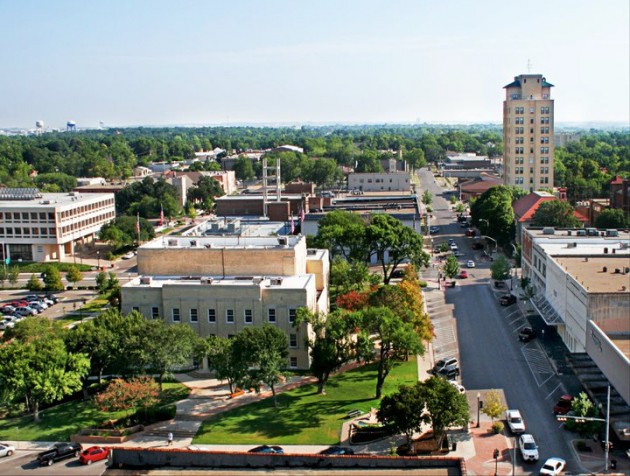
Temple's own development language points in the same direction. The Temple Economic Development Corporation markets the city as positioned between Dallas and Austin on the I-35 corridor, says businesses can reach 28 million people within two-and-a-half hours, and describes 2,000 acres of shovel-ready land with costs below the national average. Its logistics page also frames Temple around the crossroads of I-35 and planned I-14, dual BNSF and Union Pacific rail access, and a freight corridor that moves roughly $750 billion in goods through Central Texas each year.
That does not prove Temple is infrastructure-ready for every large digital project.
But it does show that the ingredients now being marketed by smaller cities are no longer generic civic bragging points. They are the same categories site selectors care about when projects become land-heavy, power-hungry, and timeline-sensitive.
Why It Is Happening
Small cities are suddenly competing because the bottleneck has shifted.
For years, the prestige version of economic development was simple: attract headquarters, recruit white-collar employers, talk about quality of life, and hope status compounds. That model still exists, but AI infrastructure and other large industrial projects care about different constraints.
The first constraint is land assembly.
A large digital campus is not a normal office lease. It needs room for substations, cooling, security setbacks, stormwater handling, parking, staging, backup systems, and future phases. In crowded metro markets, land is expensive, fragmented, and politically contested. Mid-sized cities and rural counties can sometimes offer cleaner parcels and fewer immediate conflicts.
The second constraint is power.
This is the real reason the conversation is changing so fast. When ERCOT has to build a special process around loads of 75 megawatts or more, the public is no longer talking about ordinary business recruitment. It is talking about projects large enough to affect transmission planning, substation timing, backup generation, and ratepayer trust. A smaller city does not win because it sounds innovative. It wins if the utility path is believable.
The third constraint is infrastructure adjacency.
Temple is useful here as an example. The city's economic pitch is not based on software culture. It is based on corridors, industrial land, rail, workforce reach, airport access, and distance to major markets. That is closer to the language of logistics and manufacturing than to the language of startups, and that is exactly the point. The next competition is being shaped by physical systems.
The fourth constraint is speed.
Large companies increasingly care about whether a place can move from site control to construction without years of confusion. That includes permitting, road access, contractor availability, utility coordination, and public communication. A smaller city can be attractive if it is easier to navigate than a larger market. It can also fail quickly if it has good marketing but weak execution.
This is where people often get the jobs conversation wrong.
The direct permanent headcount for a data center or other automated facility may be smaller than the public imagines. But the wider effect can still be significant through construction labor, electricians, fiber crews, maintenance, security, engineering, local suppliers, restaurants, housing pressure, tax base, and utility upgrades. That does not mean every project is worth approving. It means "how many permanent jobs?" is not the only serious question.
The better question is: what system commitments is the city making, and what does it get back?
For Temple, that is the useful lens. The city does not need to become Austin to enter the map. It needs to know which parts of its pitch are real operational advantages and which parts are still brochure language.
Questions that matter more than slogans:
- How much electric capacity is actually available on a realistic timeline?
- Which upgrades would be paid for privately, and which could spill into broader public costs?
- What water source, cooling method, and wastewater assumptions would a project rely on?
- Which roads, rail access points, and contractor networks make the site buildable in practice?
- How would the public be told what is known, unknown, and negotiable before a deal hardens?
Small cities are competing because the modern project map is looking for room, power, access, and coordination.
The city that can document those things has leverage.
The city that can only market them does not.
What Might Happen Next
My forecast is that more mid-sized communities will start sounding less like tourism brochures and more like infrastructure prospectuses.
They will market shovel-ready acreage, interconnection pathways, water plans, fiber proximity, rail access, and workforce pipelines. Some of that language will be real. Some of it will be aspirational. The gap between those two will matter a lot.
I also expect the strongest projects to keep landing in places that sit near large markets without carrying the full cost structure of those markets. That could mean more Abilene-style and Shackelford-style examples in Texas, and more pressure on Central Texas communities to decide what kind of growth they actually want to host.
For Temple specifically, the likely future question is not whether it can become a glamorous technology city.
It is whether it can become a credible infrastructure city.
Those are different ambitions.
A credible infrastructure city knows its power constraints, its water exposure, its land inventory, its contractor depth, its transportation advantages, and its political limits. It knows what to demand from developers before public trust is spent. It can tell residents where the benefits are real, where the risks are real, and where uncertainty still has to stay on the table.
If Temple and places like it do that work early, smaller cities can compete from a position of clarity instead of desperation.
If they do not, they may still attract attention, but they will negotiate from hype while someone else writes the terms.
That is the real shift.
The competition is no longer just for status.
It is for infrastructure credibility.
Sources
- Lawrence Berkeley National Laboratory, United States Data Center Energy Usage Report: 2025 Update (June 2026): https://eta-publications.lbl.gov/publications/united-states-data-center-energy-2025
- International Energy Agency, Energy and AI (April 10, 2025): https://www.iea.org/reports/energy-and-ai/
- International Energy Agency news release summarizing the report (April 10, 2025): https://www.iea.org/news/ai-is-set-to-drive-surging-electricity-demand-from-data-centres-while-offering-the-potential-to-transform-how-the-energy-sector-works
- ERCOT news release, "PUCT Approves ERCOT's Batch Zero Process for Connecting Large Electricity Users While Protecting System Reliability for Texans" (June 18, 2026): https://www.ercot.com/news/release/06182026-puct-approves-ercots
- ERCOT, Large Load Integration: https://www.ercot.com/services/rq/large-load-integration
- Oracle, Abilene Data Center: https://www.oracle.com/data-centers/abilene/
- Oracle, Shackelford County Data Center: https://www.oracle.com/data-centers/shackelford-county/
- Temple Economic Development Corporation homepage: https://templeedc.com/
- Temple Economic Development Corporation, Logistics and Distribution: https://templeedc.com/key-industries/logistics-distribution/
Image credits: Temple and infrastructure images are tracked in the Pheorix image credit files.